Islington stands as one of London's most distinctive boroughs, where Georgian terraces rub shoulders with modernist council estates, and where the highest population density in England coexists with a strong sense of village identity. Covering just 5.74 square miles, making it the second smallest borough in London by area, Islington packs within its borders over 223,000 residents, ten Tube stations, world-class cultural venues, and a political heritage that has shaped modern Britain.
The Geography of a Compact Borough
The London Borough of Islington was created on 1 April 1965 through the amalgamation of the former Metropolitan Boroughs of Islington and Finsbury under the London Government Act 1963. The area's name has ancient Saxon roots, deriving from "Giseldone" in 1005 and "Gislandune" in 1062, meaning "Gīsla's hill." Historically part of Middlesex, Islington now borders the City of London to the south and the London Borough of Camden to the west.
The borough encompasses a diverse patchwork of districts, each with its own character. Angel, with its bustling Upper Street, serves as the southern gateway. Highbury retains its residential village atmosphere. Canonbury offers elegant Georgian squares beloved of artists and writers. Finsbury and Clerkenwell blend historic industrial heritage with modern creative industries. Archway, Holloway, and Tufnell Park provide more affordable residential pockets while maintaining strong community identities.
A Density Like No Other
Islington holds the distinction of being the most densely populated local authority in the United Kingdom. According to the 2011 census, the borough recorded 13,875 people per square kilometre, compared to a London average of 52.0. This extreme density shapes daily life in tangible ways: streets bustle with foot traffic, independent shops thrive on local patronage, and the sense of being part of a crowded, energetic city is ever-present.
The population has fluctuated dramatically over the decades. Before the First World War, Islington was home to approximately 400,000 people, many crammed into Victorian terraced housing. Post-war slum clearances and suburbanisation saw numbers plummet, bottoming out in the 1980s before reversing as gentrification took hold. The 2021 census recorded 216,590 residents, with the 2024 estimate at 223,024.
Markets, High Streets, and the Local Economy
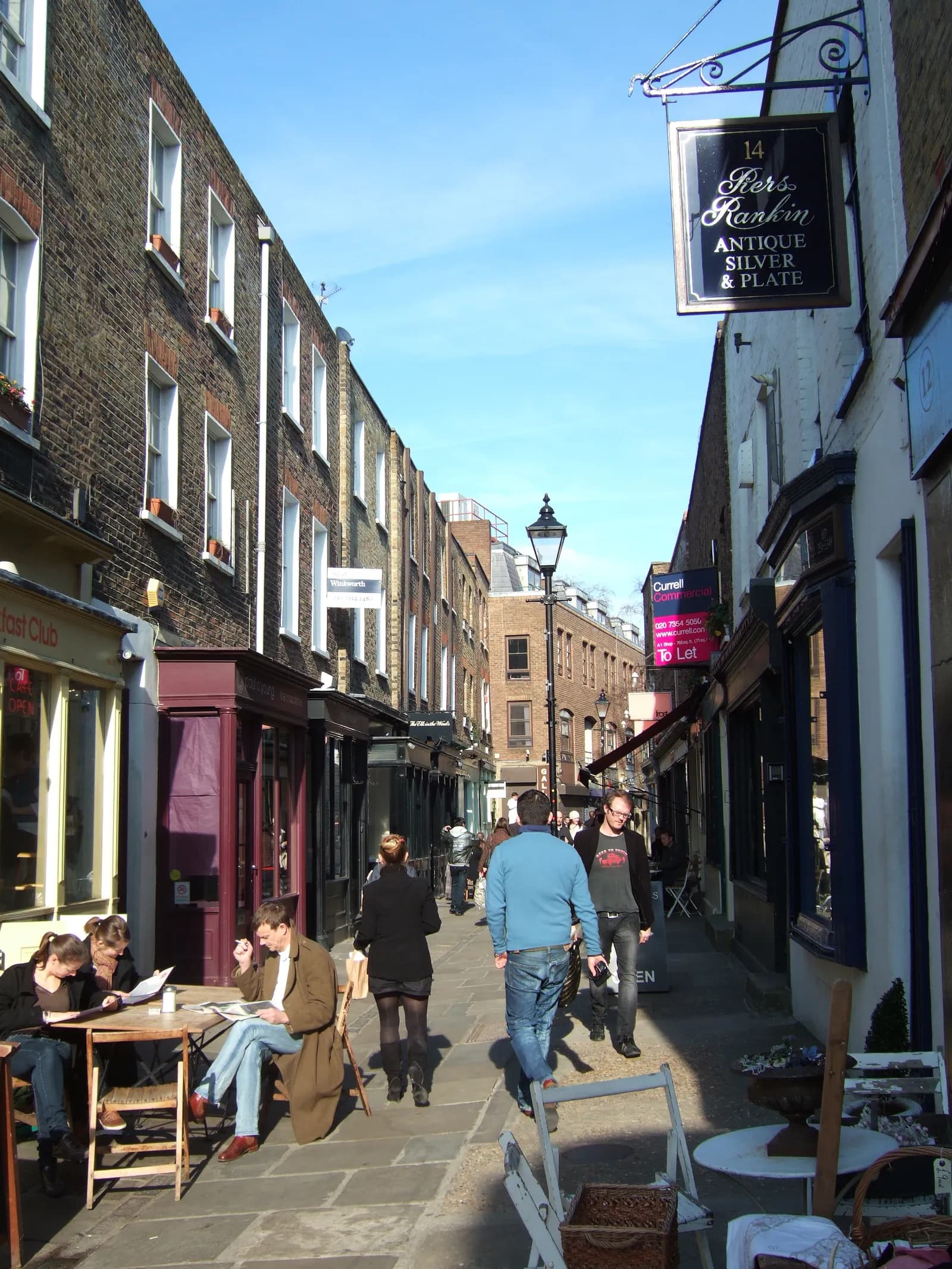
Despite its urban density, Islington retains a strong market culture that serves as the social and economic backbone of the borough. Chapel Market, with its 224 stalls operating Tuesday through Sunday, offers everything from fresh produce to household goods. Camden Passage, with its 32 antiques traders and historic tram sheds, has drawn collectors since the 1960s. Exmouth Market has transformed from a declining retail strip into a thriving food destination with 32 stalls and numerous restaurants.
The Angel Business Improvement District covers parts of southern Islington and Clerkenwell, supporting local traders and managing the public realm. The Business Design Centre on Liverpool Road, originally the Royal Agricultural Hall built in 1862 and once capable of holding 50,000 people, now hosts exhibitions and events.
Culture and Landmarks
Islington's cultural offering punches well above its weight. Sadler's Wells Theatre on Rosebery Avenue is recognised as a world-leading dance venue; the current building dates from 1998, though six theatres have occupied the site over the centuries. The Union Chapel on Upper Street, a Grade I listed Congregational church built between 1874 and 1877, doubles as a 1,500-capacity music venue and hosts the Margins Project for homeless individuals.
The Almeida Theatre on Almeida Street, housed in a former literary institution dating from 1837, maintains its reputation for avant-garde productions. The Little Angel Theatre specialises in puppetry, whilst the Estorick Collection in Canonbury Square holds an important collection of modern Italian art. Islington Museum, opened in 2008 with a £1 million Heritage Lottery Fund grant and located in Finsbury Library, tells the borough's story through artefacts including a bust of Lenin and original Joe Orton book covers.
Sporting culture centres on the Emirates Stadium in Holloway, which opened on 22 July 2006 at a cost of £390 million. With a capacity of 60,704, it replaced Arsenal's historic Highbury ground and became home to Arsenal Women in 2024.
Transport Connections
Islington benefits from exceptional transport links for a borough of its size. Ten London Underground stations serve the area: Angel and Archway on the Northern Line; Arsenal, Caledonian Road, Finsbury Park, and Holloway Road on the Piccadilly Line; Old Street on the Northern Line and National Rail; and Highbury and Islington on the Victoria Line and London Overground. Farringdon station provides Circle, Hammersmith & City, Metropolitan, and Elizabeth Line services.
London Overground stations at Caledonian Road & Barnsbury, Canonbury, Crouch Hill, and Upper Holloway connect residents to the orbital network. National Rail services run from Essex Road, Drayton Park, and other stations. The 2011 census revealed how residents commute: 19.4 per cent use the Underground, 10.3 per cent travel by bus, 10.3 per cent walk, and 6.2 per cent cycle.
Angel tube station holds a notable record: its escalator, with 318 steps, is the longest on the London Underground network.
Literary and Political Heritage
Islington has long attracted writers, artists, and thinkers. Charles Dickens set portions of Oliver Twist, David Copperfield, and Bleak House in the area. George Gissing's The Nether World captured its Victorian working-class life. Douglas Adams lived in Arlington Avenue; Neil Gaiman set portions of Neverwhere here. More recently, Nick Hornby's About a Boy painted a picture of modern Islington life.
The borough's political significance extends beyond its literary connections. The area is widely regarded as a stronghold of the British left, with The Guardian describing it in 2006 as "the spiritual home of Britain's left-wing intelligentsia." Jeremy Corbyn represented Islington North as an MP from 1983 to 2024, including his tenure as Labour leader. Emily Thornberry continues to represent Islington South and Finsbury.
The "Granita Pact," the alleged 1994 agreement between Tony Blair and Gordon Brown regarding the Labour leadership, is said to have been struck at a now-defunct restaurant on Upper Street. Blair himself lived in Islington before entering Downing Street.
Looking Forward
Islington continues to evolve. The opening of the Elizabeth Line at Farringdon in 2022 has strengthened connections to east London and beyond. Sadler's Wells East opened in February 2025 at the Queen Elizabeth Olympic Park in Stratford, extending the theatre's reach. Meanwhile, traders at Chapel Market have expressed concerns about declining footfall, illustrating the challenges facing traditional retail in an era of online shopping.
What remains constant is Islington's ability to balance the intimate and the metropolitan. Within its compact boundaries, residents find village-like communities, independent businesses, and cultural institutions that would be the envy of much larger cities. It is this distinctive combination, forged through centuries of history and decades of change, that defines Islington's enduring character.